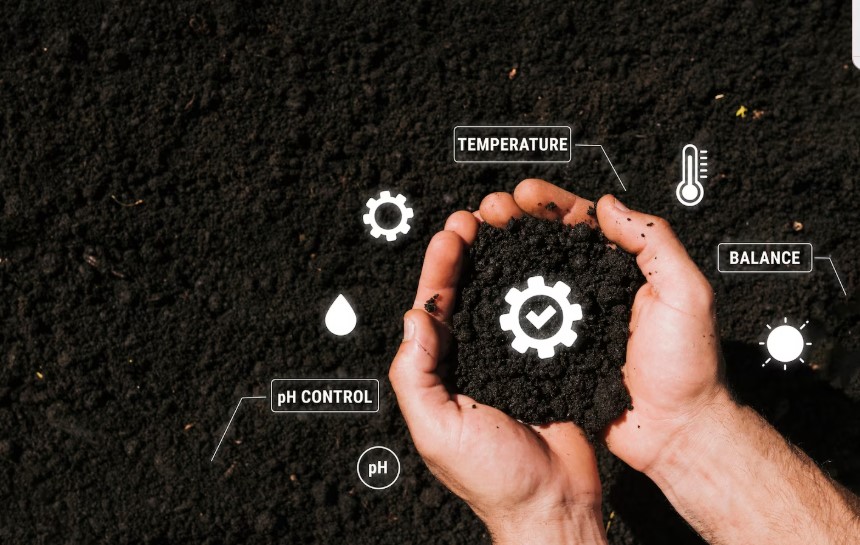

“Healthy soils are one of the planet’s largest carbon sinks”
This blog explains the concept, importance, calculation steps, and practical applications of soil carbon stock estimation using standard soil parameters.
Introduction
Soil plays a critical role in the global carbon cycle and climate change mitigation. One of the most important indicators of soil health and climate-smart agriculture is soil carbon stock, which represents the amount of carbon stored in soil over a given area and depth. Understanding how to calculate soil carbon stock from routine soil test data helps researchers, practitioners, and policymakers translate laboratory values into meaningful indicators for land management and carbon accounting.
Soil carbon stock refers to the total amount of carbon stored in the soil per unit area (usually expressed as tonnes per hectare) up to a specified depth. It is derived from:
- Soil organic carbon content (OC%)
- Soil bulk density (BD)
- Sampling depth
Unlike soil carbon concentration (%), carbon stock reflects the actual quantity of carbon stored, making it more relevant for climate change studies and land-use planning.
Why Soil Carbon Stock Matters?
Accurate estimation of soil carbon stock is essential for:
- Climate change mitigation and carbon sequestration assessment
- Monitoring soil health and degradation
- Evaluating the impact of land-use and management practices
- Reporting for climate-smart agriculture and carbon projects
“Carbon concentration tells a story, but carbon stock reveals the full impact.”
Step-by-Step Calculation of Soil Carbon Stock
Step 1: Carbon Stock per Unit Area (cm²)
Soil carbon stock (g/cm2) = OC% * mass (g) of the soil
or, Soil carbon stock (g/cm2) = OC% * bulk density (BD) (g/cc) * Volume (cm3)
or, Soil carbon stock (g/cm2) = OC% * bulk density (BD) (g/cc) * Area (cm2) * soil depth (cm)
Since area is unit cm2 (i.e. 1cm2),
Soil carbon stock (g/cm2) = OC% * bulk density (BD) (g/cc) * soil depth (cm)
“A small increase in soil carbon across agricultural lands can offset millions of tonnes of atmospheric CO₂.”
Step 2: Conversion to Square Meter (m²)
We have, 1m2 = 10000cm2
Soil carbon stock (g/m2) = (OC%)/100 * bulk density (BD) (g/cc) * 10000 * soil depth (cm)
or, Soil carbon stock (g/m2) = (OC%)/100 * bulk density (BD) (g/cc) * 10000 * soil depth (cm)
or, Soil carbon stock (g/m2) = OC% * bulk density (BD) (g/cc) * soil depth (cm) * 100
Step 3: Conversion to Hectare (ha)
We have, 1ha = 10000m2
Soil carbon stock (g/ha) = OC% * bulk density (BD) (g/cc) * soil depth (cm) * 100 * 10000
or, Soil carbon stock (g/ha) = OC% * bulk density (BD) (g/cc) * soil depth (cm) * 1000000
Step 4: Conversion to tonn per Hectare (ha)
We have, 1tonn = 1000000g
Soil carbon stock (tonn/ha) = (OC% * bulk density (BD) (g/cc) * soil depth (cm) * 1000000) / 1000000
or, Soil carbon stock (tonn/ha) = OC% * bulk density (BD) (g/cc) * soil depth (cm)
This simplified equation is widely used in soil science, carbon accounting, and climate studies
Example
Assume: OC = 1.5% , Bulk density = 1.3 g/cc, Depth = 30cm
Soil carbon stock (tonn/ha) = OC% * bulk density (BD) (g/cc) * soil depth (cm)
Thus, Soil carbon stock: = 1.5 × 1.3 × 30 = 58.5 t/ha
This means the soil stores 58.5 tonnes of carbon per hectare within the top 30 cm.
“Managing soil carbon is managing the future of agriculture and climate.”
Key Considerations and Limitations
- Bulk density should ideally be measured, not assumed
- Carbon stock depends on sampling depth; so always report depth
- Changes in land use and management strongly affect carbon stock
- Only use organic carbon percentage for calculation. Do not use organic matter percentage or adjustment with 100 for calculation
Conclusion
Soil carbon stock estimation transforms basic soil test data into a powerful indicator of soil health and climate mitigation potential. By combining organic carbon percentage, bulk density, and sampling depth, practitioners can quantify how much carbon is stored in soil and how management practices influence long-term sustainability.
Understanding and applying soil carbon stock calculations is essential for advancing climate-smart agriculture, sustainable land management, and evidence-based policy decisions.